Start with the material
Drop each source where it belongs. Give cards descriptive titles, preserve the original asset, and add categories or tags that will remain useful when the board grows.
 Infinite Whiteboard
Research + synthesis
Place sources beside the claims they support. Separate observations from conclusions. Keep unanswered questions visible until the research actually resolves them.
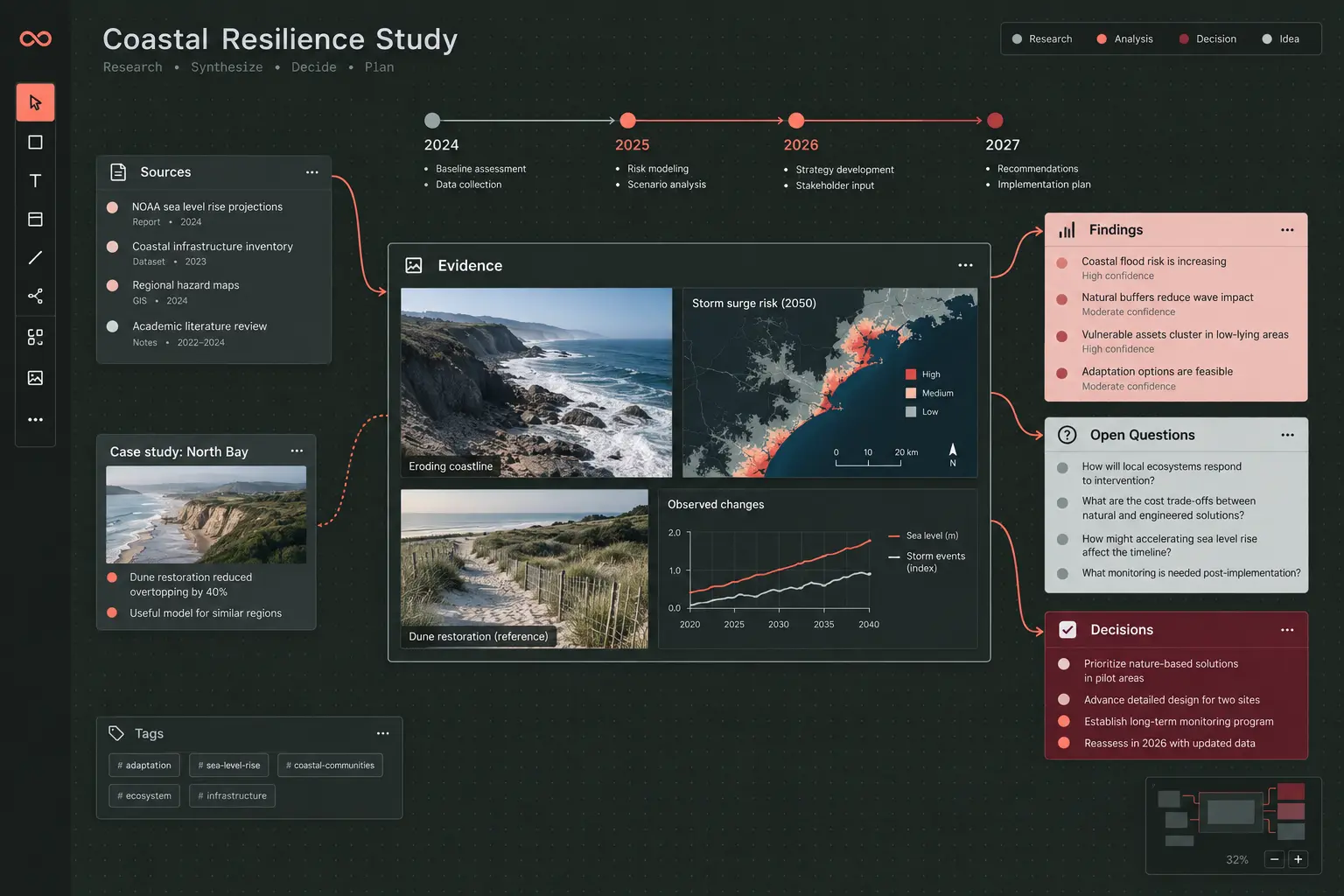
A visible chain of reasoning
Research becomes difficult to navigate when source notes, images, questions, and decisions live in separate applications. A spatial board keeps those materials close enough to compare. Connections make the reasoning explicit: which source supports a finding, which observation creates a question, and which evidence changed a decision.
Infinite Whiteboard does not impose one research method. Frames can separate literature, field evidence, competing interpretations, or workstreams. Categories and tags cut across those frames. An era or numeric axis can show publication dates, project phases, confidence levels, or any other ordered dimension.
Drop each source where it belongs. Give cards descriptive titles, preserve the original asset, and add categories or tags that will remain useful when the board grows.
Place evidence side by side, align related cards, and frame clusters. Use color as a restrained semantic cue rather than a substitute for labels.
Draw labeled connections from source to observation, finding, question, or decision. Direction and line style can distinguish support from contradiction or uncertainty.
Maintain a dedicated frame for open questions and missing evidence. A visible gap is easier to investigate than a forgotten item in a document outline.
Use the minimap for orientation, bookmarks for recurring sections, layers for hidden or locked items, and search to jump directly to a source or concept.
Export a focused PNG for a briefing or keep the complete ZIP as the durable, editable record with every original uploaded asset included.