Begin with the premise
Place the central conflict, theme, or question where it can remain visible. Build outward from the few ideas that every other choice needs to support.
 Infinite Whiteboard
Stories + worlds
Keep characters close to the places, histories, motives, and conflicts that shape them. A connected canvas reveals continuity problems and new story possibilities before they disappear into separate documents.
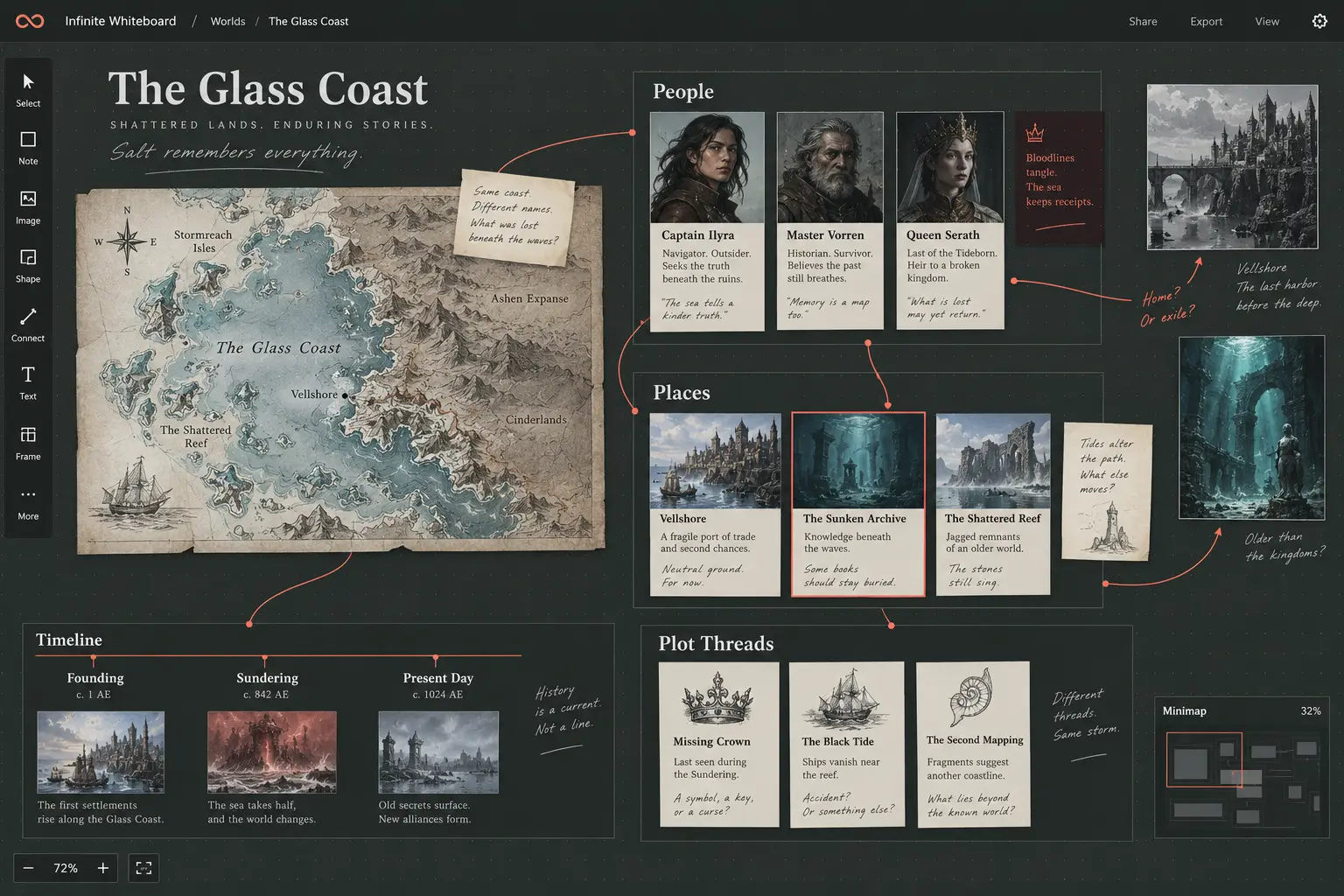
Context at a glance
Stories rarely develop in a straight line. Character goals affect political factions; old events explain current conflict; a location can hold both plot function and visual atmosphere. Infinite Whiteboard lets those relationships remain visible without forcing every idea into the same hierarchy.
Use frames to separate regions, acts, factions, or research. Attach events to a timeline, connect a secret to the characters who know it, and place reference images beside the notes they inform. Collapse detail when you want to concentrate on the main arc, then expand it when continuity matters.
Place the central conflict, theme, or question where it can remain visible. Build outward from the few ideas that every other choice needs to support.
Create one card per major character, then connect alliances, obligations, secrets, and conflicts. Directional paths help distinguish who acts from who reacts.
Pair maps and reference images with notes about culture, atmosphere, resources, and plot function. Frames can hold regions without flattening their internal detail.
Place historical and story events on a shared axis. Cards attached to values move with the timeline, making gaps, overlaps, and impossible travel easier to notice.
Use categories, tags, colors, and labeled paths to trace promises, mysteries, transformations, and consequences across acts or chapters.
Rearrange whole clusters, save a checkpoint before a major revision, and export the full board when you want a durable snapshot of the world.